Choosing a Hardwood Stain Color for Inland Empire Light
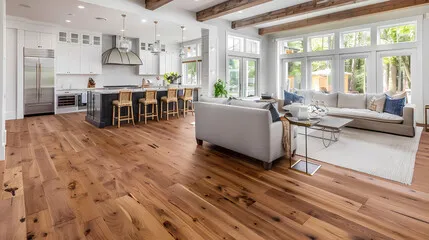
Stain color is the decision homeowners lose the most sleep over during a refinish, and the one most often chosen from a two-inch chip under fluorescent light. In the Inland Empire, where rooms get hours of hard, bright sun, that chip lies more than it does almost anywhere else.
Here is how to choose a color you will still like in ten years.
Stain tints the wood; it does not cover it
Whatever the wood already is, the stain works with it. The same can of stain looks different on every species.
- Red oak has a pink undertone and a strong grain. Warm browns look right on it. Gray and cool stains fight the pink and go muddy.
- White oak is the neutral. A faint green undertone cancels red, so it takes warm, cool and natural stains cleanly. It is why white oak has become the default new floor. Our oak flooring guide shows the two side by side.
- Hickory is naturally two-toned, cream and brown in the same board. Stain narrows the range but does not remove it.
- Maple is dense and takes stain unevenly. Dark stains blotch. Keep maple light or natural.
If you are installing new wood rather than refinishing, choose the species for the color you want. Our species and finishes post covers durability alongside looks.
The finish changes the color too
Oil-based polyurethane adds an amber cast the day it goes on and keeps yellowing for years. On a warm brown that can be lovely. On a natural or light stain it turns the floor orange within a few years, and that is the most common color regret we hear about.
Water-based finishes stay clear. The color you approve is the color you keep. If you want a pale, natural white oak floor, water-based is the only way to hold it there.
What Inland Empire light does to each color
Our light is the opposite of the soft, gray light that made cool stains popular in wetter parts of the country. It is intense, warm, and direct for most of the day.
Very light and natural floors look bright and clean in it, and they hide dust well. They show scratches least. The risk is glare in a room with a lot of glass, and yellowing if you use an oil finish.
Medium warm browns are the safe middle. They read as warm without going orange, hide dirt and dust better than either extreme, and pair with almost any cabinet color. Most of the floors we stain in the Inland Empire land here.
Dark browns and ebony are dramatic and elegant, and they are a commitment here. Direct sun on a dark floor shows every speck of dust, every paw print and every fine scratch. With dogs and open sliders, expect to sweep daily. Dark floors also fade more visibly in sun, because there is more color to lose. Our sun fading post explains why.
Gray and cool greige have faded from fashion, and in our light they never quite worked: strong warm sun on a gray floor reads as flat and slightly dirty. If you are refinishing a gray floor, most homeowners are moving to a warm natural or a medium brown. Our 2026 trends post covers where the market has gone.
Matching the rest of the room
The most common mistake is matching the floor to the cabinets or the furniture too closely. When the floor and the kitchen island are the same brown, they merge into one block. Aim for contrast in lightness, not just tone: a medium floor under white cabinets, a lighter floor under dark cabinets, and a floor a shade or two away from any wood furniture that sits on it.
Trim and stair parts are simpler. Match them to the floor exactly or paint them. Half-matched wood tones look like an accident.
The test that prevents regret
We never stain a whole floor from a chip. During a refinish, we sand a test area and apply two or three candidate stains side by side on your actual boards, then seal the samples with the finish you have chosen so you see the real end result, amber cast and all. You look at them in the morning and again in the afternoon sun, and you sign off before we stain the room.
On an existing floor we do this as a two-by-two-foot patch. On new prefinished wood we bring full-size boards, not chips, because a three-inch sample tells you almost nothing about how a floor reads across a room.
Sheen is a separate decision
Sheen, from matte to semi-gloss, changes how much light the floor throws back, and in a bright room a lower sheen hides more and glares less. It is a separate choice from color and easier to change later with a recoat. Our sand and stain guide covers both.
Ready to see real colors on your real floor? Book a free estimate and ask for a stain test as part of the refinishing quote.
Frequently asked questions
- What is the most popular hardwood floor stain color right now?
- Warm, natural mid-tones. After a long run of gray and cool greige, most floors we stain in the Inland Empire now land between a natural white oak and a light-to-medium warm brown. Very dark espresso and true gray have both fallen off sharply.
- Are dark hardwood floors a bad idea in a sunny house?
- They are a commitment. Direct sun on a dark floor shows every speck of dust, paw print and fine scratch, and dark floors fade more visibly because there is more color to lose. Medium warm browns give most of the depth with far less daily upkeep.
- Why does my stain look different from the sample chip?
- Three reasons: the species underneath (red oak pulls pink, maple blotches), the finish on top (oil-based ambers, water-based stays clear), and your light. The only reliable test is a stained and sealed sample on your own floor, viewed in morning and afternoon sun.
- Can you change the color of existing hardwood floors?
- Yes, if the floor is solid hardwood or engineered with a thick enough wear layer to sand. Refinishing takes the floor to bare wood and the new stain goes on fresh. We test candidate colors on your floor and you approve one before the whole room is stained.