Laminate vs. Hardwood: The Real Cost Difference Over 10 Years
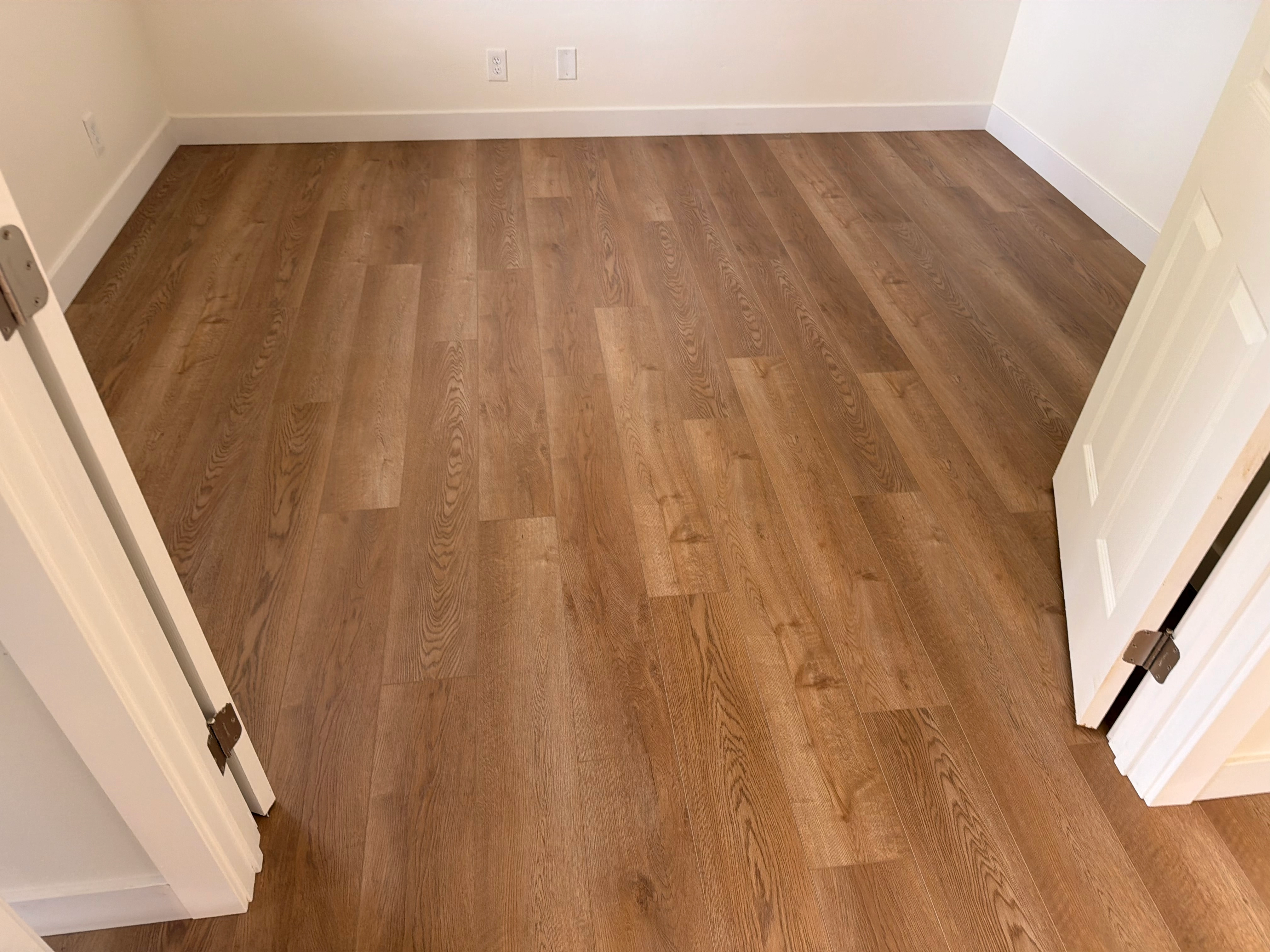
Ask what laminate costs versus hardwood and you get two numbers that make the decision look obvious. Laminate runs roughly $4 to $8 per square foot installed in the Inland Empire. Hardwood runs $8 to $16. Laminate wins, next question.
Except that is the purchase price, not the cost. Over the time you actually own the floor, three things move the comparison, and on a house you plan to keep, they can close the gap entirely.
The day-one number
Start honest. For 1,000 square feet:
- Laminate: roughly $4,000 to $8,000 installed
- Hardwood: roughly $8,000 to $16,000 installed
That is a real difference and it is why laminate exists. If cash today is the binding constraint, laminate is a legitimate answer and we install a lot of it. Our laminate flooring installation page covers what we put down and why.
Factor one: how long each floor lasts before it is replaced
This is the biggest lever, and it is where the two products separate.
Laminate has a service life, not a lifespan. Good AC4 or AC5 laminate in a normal household runs 15 to 25 years before the wear layer gives out or the seams start to show their age. When that happens there is no repair path. The wear layer is a printed photographic layer under melamine, and once it is worn through, the plank is finished. The floor comes out.
Hardwood is refinishable. Solid 3/4-inch hardwood can be sanded and refinished four to seven times, and each refinish resets the surface completely. A hardwood floor that gets refinished on schedule genuinely lasts the life of the house. We refinish oak in Redlands and Riverside that was installed before 1950.
Run that over 30 years on 1,000 square feet:
- Laminate: install at year 0, replace around year 20. Two installations.
- Hardwood: install at year 0, refinish around year 12 and year 24. One installation, two refinishes at roughly $3 to $8 per square foot each.
The second laminate installation costs about what two hardwood refinishes cost, and at the end of it you have a 10-year-old laminate floor rather than a 30-year-old hardwood floor that looks new.
Factor two: repairability
Damage happens. What differs is what happens next.
A gouged, water-swollen, or deeply scratched laminate plank cannot be repaired. It has to be replaced, and if it is in the middle of a floating floor, that means unlocking planks back to the wall or cutting the plank out and gluing a replacement in. It is doable and we do it, but the replacement will not match perfectly if the floor has aged or the product has been discontinued, which after eight or ten years it usually has.
Hardwood repairs disappear. A damaged board gets cut out, a new one gets woven in, and the whole area gets sanded and refinished as one surface. Done properly, you cannot find it afterward. Our floor repair page covers what that looks like, and the scratch and gouge repair guide has the detail.
Factor three: resale
Real estate listings say hardwood floors. They do not say laminate floors. Whether that is fair is beside the point, buyers respond to it, and appraisers and agents treat hardwood as a feature and laminate as neutral.
If you are selling in two years, this argues for spending less, not more, since you will not recover a full hardwood premium in that window. If you are staying ten years and selling after, hardwood is carrying value the whole time. Our post on flooring and resale value goes further.
Where laminate is genuinely the right answer
None of this makes laminate a bad product. It is the correct choice in several real situations:
- Rental and investment property. Tenants are hard on floors, the exit is a full replacement either way, and durability per dollar is what matters. See flooring for rental properties.
- You are moving within a few years. You will not be there for the refinish that makes hardwood pay off.
- Rooms where wood is the wrong material anyway. Laundry rooms, some bathrooms. Though in those, luxury vinyl plank usually beats laminate outright because it is waterproof rather than water-resistant.
- The budget is the budget. A laminate floor you can afford now beats a hardwood floor you cannot. This is a real and sufficient reason.
The version that actually decides it
Ask yourself one question: how long will I own this house?
Under about seven years, buy on the day-one number. Laminate, and do not overthink it.
Over about fifteen years, run the 30-year math above, because you are going to live through the replacement cycle. Hardwood's cost advantage is deferred but it is real.
In between, it comes down to how much the look matters to you and how hard your household is on floors.
One thing that is not a cost argument
Laminate and hardwood do not feel the same or sound the same underfoot, and no spreadsheet captures that. Laminate over an underlayment on a slab has a characteristic slightly hollow sound. Nailed solid hardwood does not. Some people never notice. Some people notice every day for fifteen years.
Before you decide on price alone, stand on both. Our hardwood vs. laminate comparison covers the performance differences, and we will bring samples to your house so you can hear the difference in your own rooms.
Want the real numbers for your square footage? Book a free in-home estimate and we will quote both.
Frequently asked questions
- Is laminate cheaper than hardwood?
- To install, yes, roughly $4 to $8 per square foot for laminate against $8 to $16 for hardwood in the Inland Empire. Over 20 to 30 years the gap narrows considerably, because laminate has to be fully replaced when its wear layer gives out while hardwood can be refinished four to seven times.
- How long does laminate flooring last?
- Good AC4 or AC5 laminate typically lasts 15 to 25 years in a normal household. When the wear layer wears through there is no repair option, the floor has to be replaced, because the visible surface is a printed layer rather than real wood.
- Can laminate flooring be refinished?
- No. Laminate has a printed photographic layer under a melamine wear coat, not real wood, so there is nothing to sand. This is the single biggest difference in long-term cost between laminate and hardwood.
- Does hardwood add more resale value than laminate?
- Generally yes. Real estate listings advertise hardwood floors as a feature, while laminate is treated as neutral. If you are selling within a couple of years the premium is unlikely to be recovered; over a longer hold, hardwood carries value throughout.